




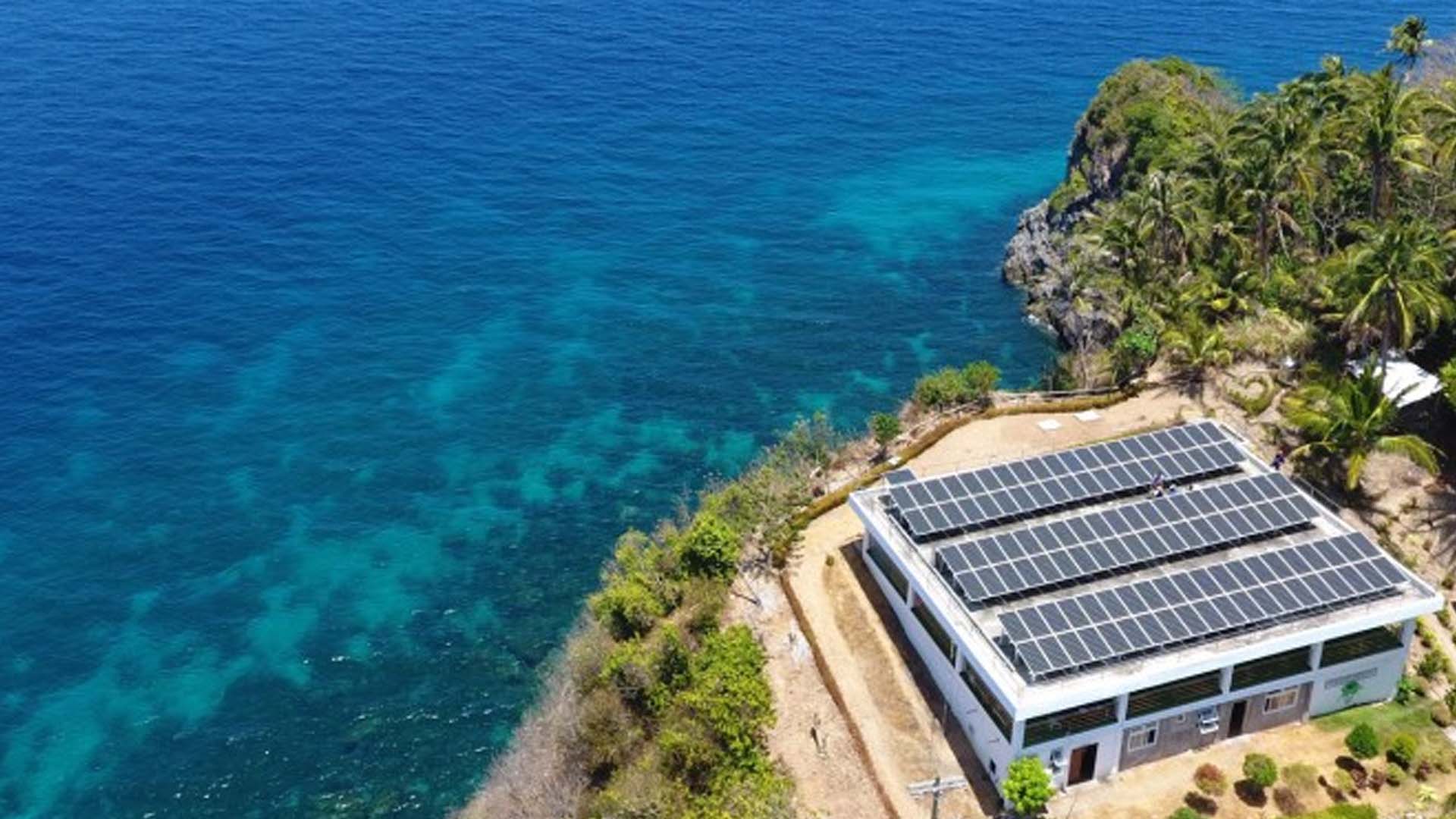







The Institute for Climate and Sustainable Cities (ICSC) will install rooftop solar photovoltaic (PV) systems in two local government buildings in Samar provinces.
The ICSC announced on Monday that recipient local government units of PV systems are Guiuan in Eastern Samar and Paranas in Samar.
The installation of solar PV systems on the rooftops of municipal buildings is part of kickstarting the use of renewable energy (RE) at the local level by driving the adoption of rooftop-mounted solar PV systems in municipal, commercial, industrial, and residential buildings.
Once completed, the projects will increase local government units’ energy independence and self-sufficiency amid frequent power interruptions and blackouts affecting the entire Samar Island, the ICSC said in a statement Monday.
“It also aims to reduce long-term power costs and increase savings for other local government investments, helping to reduce greenhouse gas emissions and dependency on fossil fuels,” the ICSC added.
The Solarize Guiuan project will install a hundred 600-watt bifacial solar panels with a total peak capacity of 60 kilowatts.
The Solarize Paranas initiative, on the other hand, will install 88 units of 555-watt bifacial panels, with a total peak capacity of 48.84 kilowatts.
Guiuan Mayor Annaliza Kwan said the town’s continued reliance on the unstable and expensive electricity coming from the grid has held the local economy back from taking off.
“Our town has been plagued by high energy costs and frequent power outages. The crisis has deterred investors and hampered fisheries production,” Kwan said in a phone interview.
Kwan said the municipal government has been helpless in addressing the problem of power instability since even Congress could not resolve it despite the numerous inquiries in the past.
She said solarization of the municipal building will inspire other establishments —both private enterprises and government agencies with offices in Guiuan with operations hampered by frequent power interruptions.
Meanwhile, Paranas Mayor Eunice Babalcon said the solarization in their town started in 2019, with the installation of PV systems to power the municipal evacuation center and municipal materials recovery facility.
“The Solarize Paranas project will fortify our solarization, especially our plans geared towards climate action, mitigation, and adaptation. Paranas understands the importance of taking care of our environment,” Babalcon said in a separate interview.
Babalcon said the local government realizes the importance of having renewable energy, especially during calamities when electricity from the grid is cut.
“When you have solar power, you can continue to use your phones and have lights in the evacuation center, which are critical during typhoons,” she added.
Under the agreement, the local governments of Guiuan and Paranas will operate and maintain their respective hybrid photovoltaic systems to be donated and installed by ICSC.
The agreement also mandates the local government to apply for net metering with their respective distribution utilities —the Samar Electric Cooperative II (SAMELCO II) for Paranas and the Eastern Samar Electric Cooperative, Inc. (ESAMELCO) for Guiuan.
This will enable the local government to sell their surplus electricity to local power cooperatives, especially those generated during weekends when there are no operations at the municipal building.
If ESAMELCO approves the application, Guiuan stands to be the first member-consumer of the distribution utility to benefit from the net metering law.
The local governments are also mandated to craft a rooftop-mounted solar power station roadmap that will identify the solar potential of public buildings in their towns and pass a Municipal Renewable Energy Ordinance institutionalizing rooftop-mounted solar in their respective locales.
In return, ICSC will provide the local governments with technical assistance in crafting and approving their roadmaps and ordinances. (PNA)