





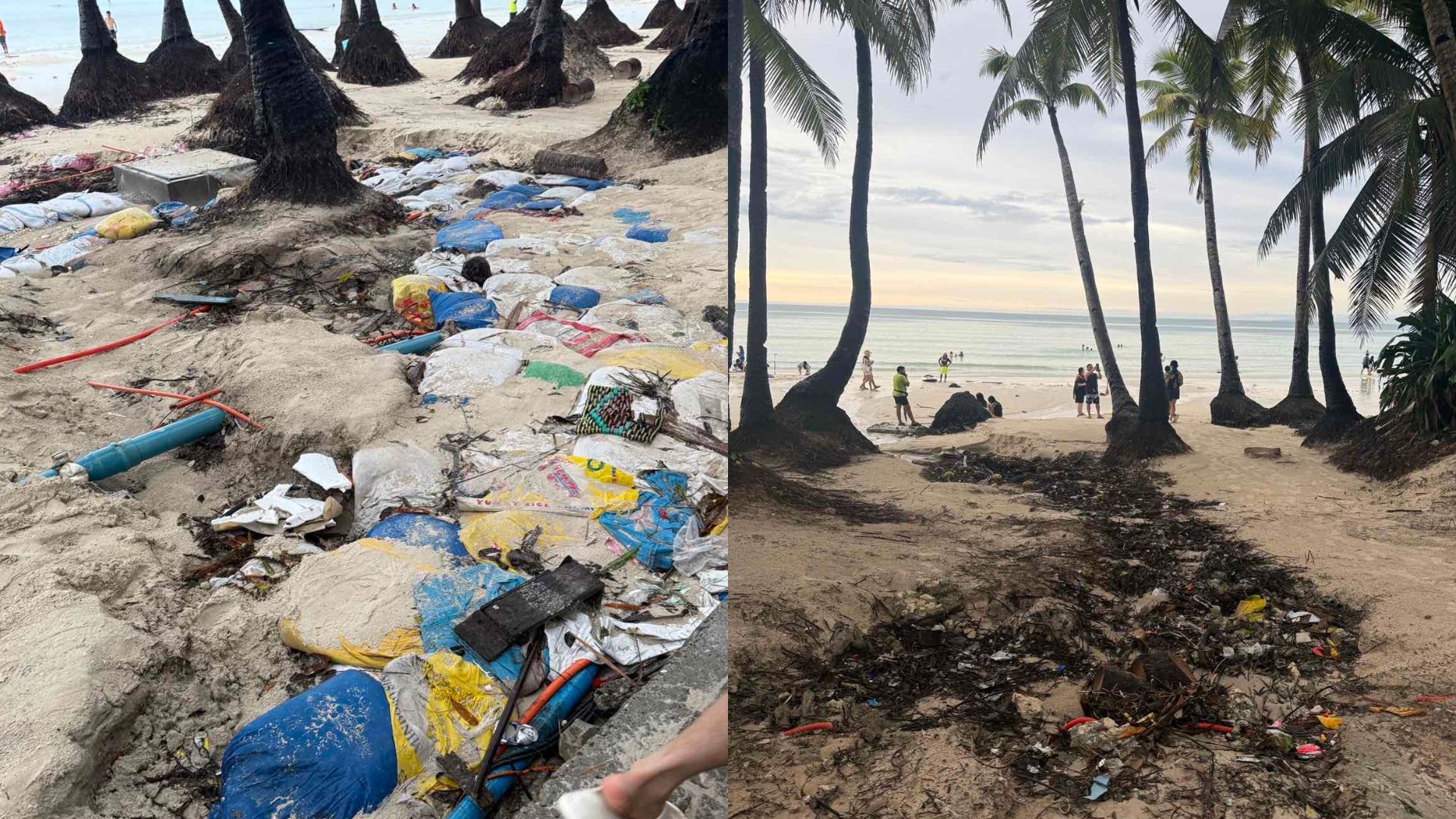







Once celebrated as one of the world’s most beautiful beaches, Boracay is again making news for the wrong reasons. What was once the pride of Philippine tourism now shows visible signs of decay and neglect.
Photos taken today reveal a disturbing sight. Sections of the beachfront are strewn with construction debris, torn sandbags, exposed drainage pipes, and piles of trash. The once-immaculate walkways are uneven and muddy. Visitors must step carefully around broken pavements and scattered litter.


For tourists expecting pristine shores, the reality is a shock. “This is not the Boracay we saw in magazines,” said a tourist from Singapore, shaking her head as she avoided a pool of runoff water.
From Paradise to Patchwork

Boracay was once the Department of Tourism’s showcase for sustainable island management. After its six-month closure in 2018 for rehabilitation, it reopened with promises of stricter regulation and long-term maintenance. Seven years later, those promises appear forgotten.
Locals say the drainage and road projects that were meant to protect the island are poorly maintained. Rainfall easily washes out sections of sand, leaving exposed sacks and pipes along the shore. Garbage from nearby establishments collects under the coconut trees. “The government says this is world-class, but we live with this mess every day,” said a resort worker in Station 2.
A Struggling Tourism Industry
The decline of Boracay’s condition comes at a time when Philippine tourism is losing ground in Southeast Asia. The latest regional statistics show the Philippines trailing behind Thailand, Vietnam, Malaysia, and Indonesia in foreign visitor arrivals.
Despite costly international campaigns such as “Love the Philippines,” actual destination management remains weak. Other countries have invested heavily in infrastructure and environmental systems, while Boracay—supposedly the country’s tourism crown jewel—now struggles with basic cleanliness and order.
Where Is the Department of Tourism?
The question many are asking is simple: where is the Department of Tourism?
Boracay is not just any beach. It is the country’s international calling card, and the most visible symbol of how the Philippines treats its natural assets. The current state of the island reveals the absence of consistent supervision and local coordination.
Tourism experts point out that the DOT continues to focus on marketing instead of long-term destination management. “The Philippines spends heavily on promotion but too little on protection,” said a tourism analyst. “Boracay is now the clearest example of this imbalance.”
A Reputation at Risk
Boracay’s name still appears in global travel rankings, but reputations are fragile. One bad experience can undo years of branding. The sight of dirty sand, exposed utilities, and neglected walkways undermines the image of a tropical paradise.


Environmental advocates warn that Boracay is becoming a symbol of broken promises. “This island should be our pride, not our embarrassment,” said one conservationist. “The government needs to act before we lose not only the tourists but also the trust of the world.”
The Call for Accountability
Boracay’s decay is not just a local concern. It mirrors a national problem in tourism management: the lack of sustained care after the photo opportunities fade.
The Philippines has what many countries envy—natural beauty, warm hospitality, and rich culture. Yet without accountability and real maintenance, even paradise can lose its charm.
Unless the DOT, local authorities, and private stakeholders step up, Boracay will remain a painful metaphor for Philippine tourism itself: full of potential but slowly eroding from neglect.
Tourism arrivals in Southeast Asia (2025)
Thailand – 28 million
Vietnam – 18 million
Malaysia – 16 million
Indonesia – 14 million
Philippines – 5.4 million
The numbers tell the story. While neighbors surge ahead, the Philippines continues to lag. If Boracay, the country’s most famous island, cannot live up to its own legend, it will be hard to convince the world that the rest of the country can.