




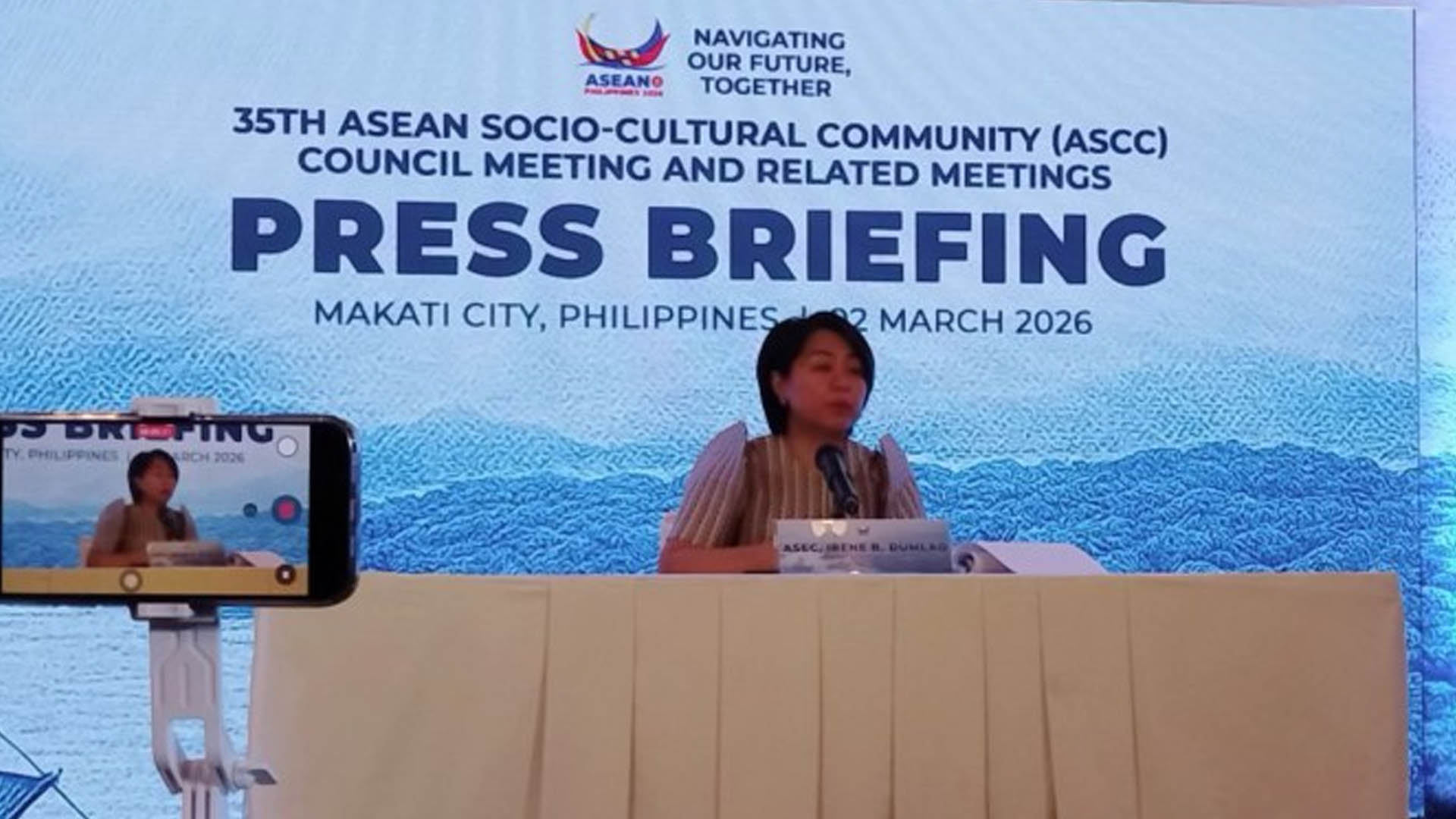







Strengthening family resilience, empowering the youth and advancing inclusive developments for marginalized and vulnerable sector will be highlighted during the three major meetings of the ASEAN Socio-Cultural Community (ASCC) this week.
Department of Social Welfare and Development (DSWD) Assistant Secretary Irene Dumlao, in a briefing Monday, said the meetings underscore the country’s “RISE ASEAN” agenda in support of “a truly ‘One ASEAN, One Response’ region.”
“These meetings emphasize our commitment to resilient families, inclusive development, smart youth innovation, and an environmentally sustainable and food-secure future,” she said.
Dumlao said the first gathering is the 40th ASEAN Socio-Cultural Community (SOCA) Meeting, where senior officials will review and harmonize key frameworks in support of the People Empowerment agenda.
The second is the High-Level ASCC Council Forum, which convenes ministers, senior officials, experts, youth leaders and development partners to put people empowerment at the forefront of ASEAN’s forward trajectory.
“The forum affirms that empowering individuals, families, and communities is both the means and the measure of ASEAN’s success,” she said.
Under the family pillar, the Philippines will promote the establishment of an ASEAN Network for Family Development, recognizing that “family is the basic unit of the society, and it plays an integral role in nation building.”
On inclusive development, Dumlao noted the region’s aging population and the need to create equal opportunities for the elderly, including advancing the “silver economy” through a regional action framework.
“With respect to the youth, we understand that a lot of them are already focused on using digital technology, so we wanted to promote opportunities that will pursue digital resilience at the same time protecting their rights and interests,” she said, adding that disaster response and multilateral support will be strengthened under the sustainability and food security agenda.
With regards to the ongoing conflict in the Middle East, Dumlao said the ASCC is closely monitoring the situation and will coordinate with partners to ensure that affected ASEAN nationals and member states receive appropriate support and assistance.
“Again, for the ASCC, the family is an important factor that we need to protect. So, yes, it will be one of the discussions or it will be one of the priority areas in the discussions,” she said.
The Philippines will also push discussions on alternative family care, including efforts to find “forever homes” for every child, as well as digital resilience to safeguard the youth from online risks.
“Our youth need to be protected also on the threats of digital technology, the use of digital technology. So, while we promote the use and the promotion of digital technologies for the development and empowerment of our youth, we need to safeguard them also from various risks that they may face,” she said.
On poverty reduction and social protection gaps, Dumlao underscored the importance of empowerment.
“Priority really is to empower our people because empowering them will address issues of poverty,” she said.
The third gathering is the 35th ASCC Council Meeting, where regional ministers are expected to formally adopt key frameworks and finalize priority social policies for Southeast Asia.
“Beyond these high-level meetings, the richness of the Filipino culture will also be highlighted through our curated gastronomic and heritage tours, and performances of traditional music and dance,” Dumlao said.
Dumlao said the Philippines is honored to welcome ministers and heads of delegation from the ASEAN Member States, led by DSWD Secretary Rex Gatchalian as ASCC Chair and Singapore’s Masagos Zulkifli as ASCC Vice Chair, along with counterparts from Brunei Darussalam, Cambodia, Indonesia, Lao PDR, Malaysia, Myanmar, Thailand, Vietnam, Timor-Leste, and the ASEAN Secretariat.
As 2026 ASEAN Chair, the Philippines is taking an active role in shaping the regional agenda through high-level dialogues on security, economic integration and social development. (PNA)