




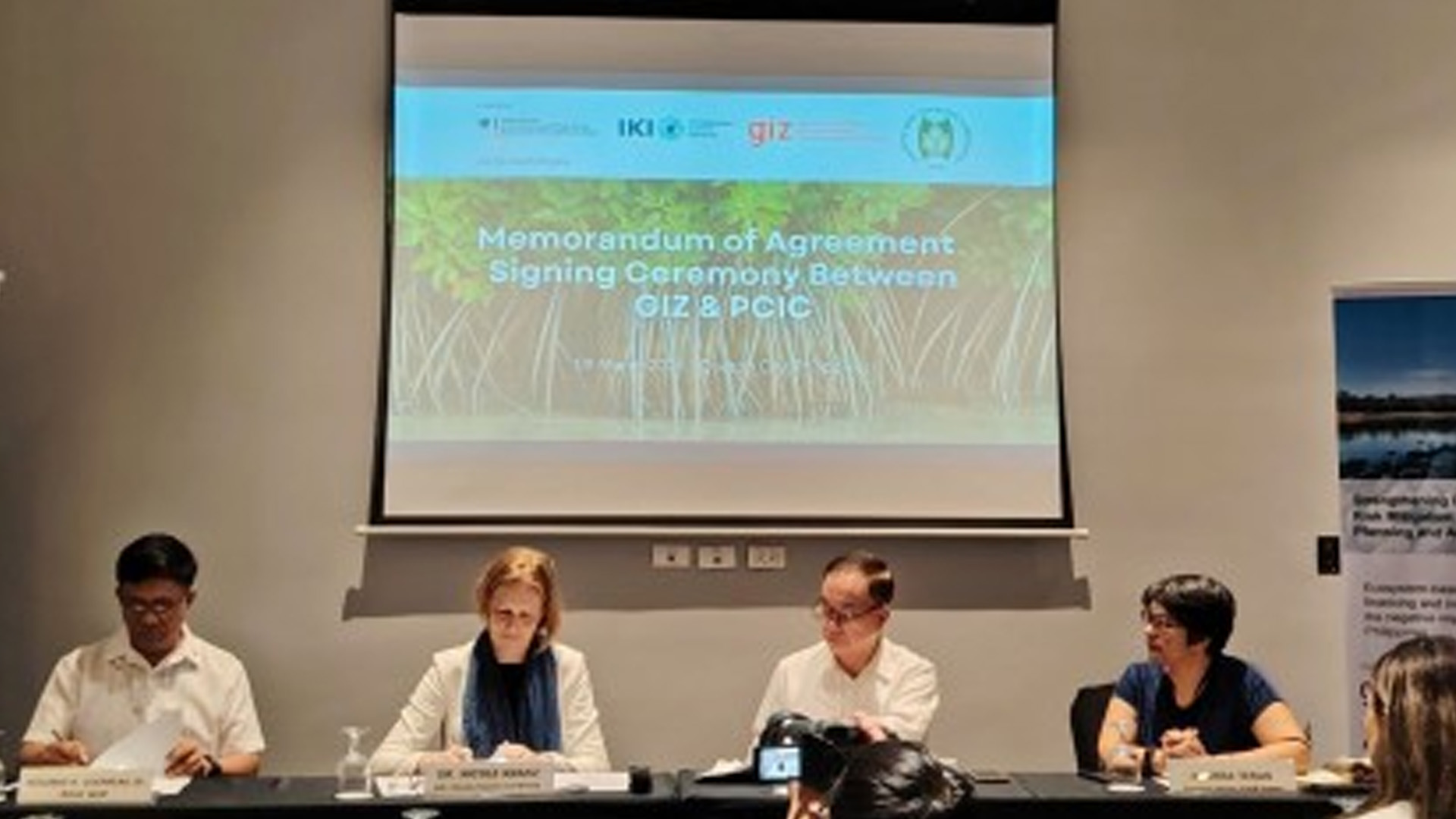







The Philippine Crop Insurance Corporation (PCIC) and the Deutsche Gesellschaft für Internationale Zusammenarbeit (GIZ) GmbH on Monday signed a memorandum of agreement (MOA) for the launching of a pilot climate-risk insurance program aimed at mitigating the effects of extreme climate conditions on the mangrove ecosystem in Eastern Visayas.
In a press conference, PCIC President Jovy Bernabe said the pioneering move will help cushion the economic impact of rising risks associated with climate change – including typhoons, storm surges, and flooding – in the region.
“Protecting mangroves through insurance of PCIC helps safeguard coastal livelihoods by reducing recovery costs after disaster or extreme climate events,” he said.
Mangroves have an estimated economic value of about PHP50,000 to PHP200,000 per year, with Eastern Visayas being third among regions with high mangrove extent, according to the GIZ.
Under the partnership, the PCIC will develop a parametric insurance product set to be simulated in Northern Samar and Southern Leyte.
“This pilot site has long been at the forefront of climate impacts. The lessons from major storms remind us that strong ecosystems are the most effective forms of natural protection,” Bernabe said.
For its part, the GIZ will fund the risk-financing mechanism and provide technical assistance under the Strengthening Disaster Resilience and Risk Mitigation through Ecosystem-based Planning and Adaptation (E4DR) Project.
“By piloting mangrove insurance in this region, we demonstrate how nature-based solutions and innovative insurance mechanisms can work together to protect both ecosystems and coastal communities,” GIZ Philippines and the Pacific Island Countries Climate Action Cluster Coordinator Nicole Kranz said.
Local government units (LGUs) will be the policyholders under the pilot project.
In 2022, the GIZ provided about EUR5.5 million for the E4DR, which will also cover the PCIC’s insurance project for mangroves.
“We are working to develop the product in two to three months, and then, hopefully, we are going to do a simulation for a couple of months again. If there’s a good dataset, results of that simulation can be piloted within the year,” PCIC business development and marketing department manager Israel dela Cruz said.
The PCIC official said the parametric insurance will cover the effects of storm surge and tropical cyclone wind signals (TCWS) in the said region.
“We have indices that represent a proxy for the damages— indices to be used for these are storm surge, which is the wave height. And also, the wind speed of typhoons or signals. So, we are looking into signal number 3,” dela Cruz said.
The typical restoration expense will be considered as a baseline for determining the cost of indemnity.
Once the product development and simulation are completed, the PCIC will conduct the pilot launch in Eastern Visayas in December. (PNA)