




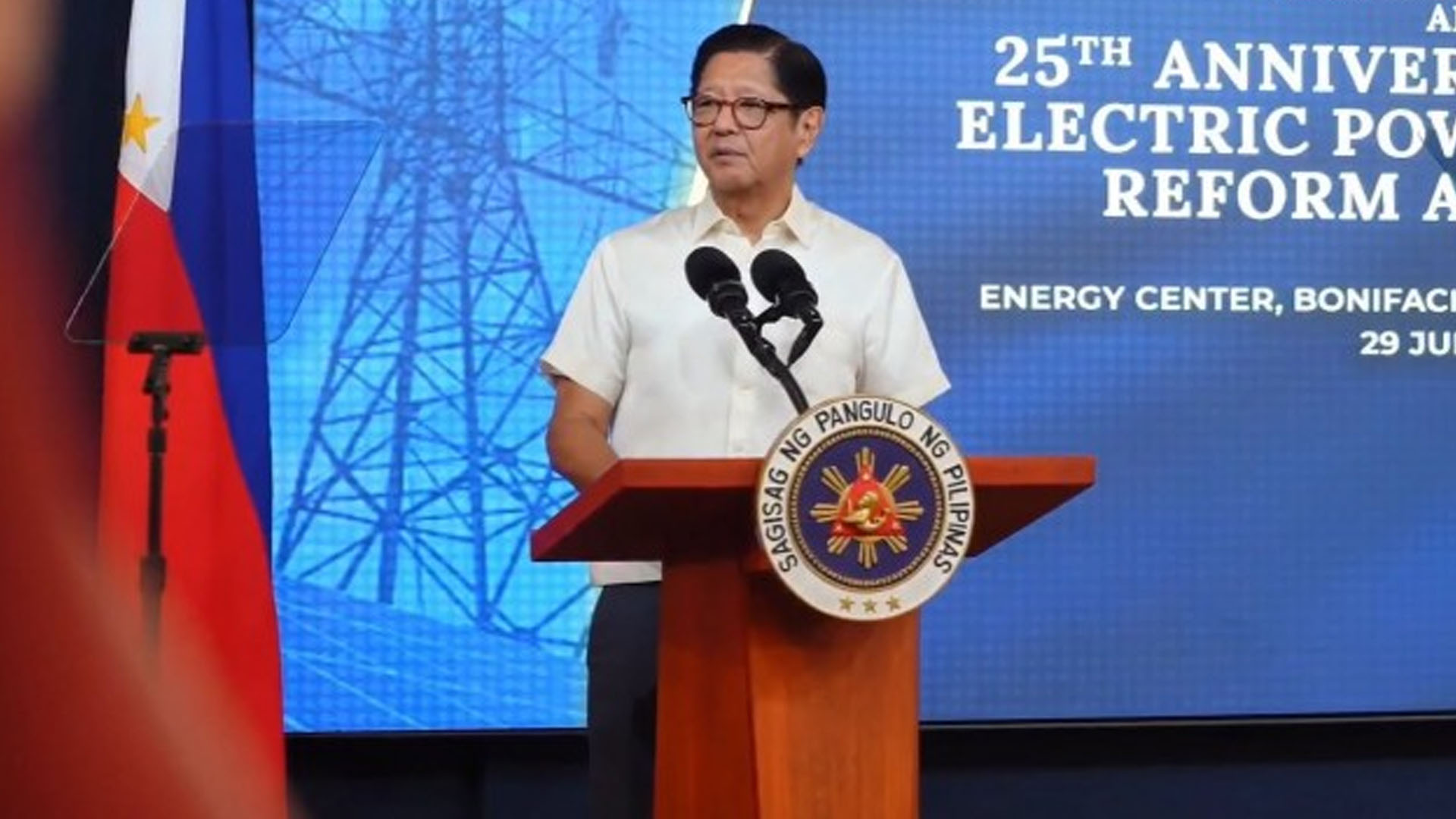







President Ferdinand R. Marcos Jr. on Wednesday inaugurated the country’s first interactive Energy Museum and renewed his push for amendments to the Electric Power Industry Reform Act (EPIRA), saying further reforms are needed to protect consumers and strengthen the country’s energy security.
Marcos led the inauguration of the Energy Museum during the 25th anniversary of EPIRA at the Department of Energy (DOE) Center.
In his speech, Marcos said the museum aims to help Filipinos better understand the critical role of energy in everyday life while promoting responsible energy use among the public.
He said the project supports his directive for the DOE to intensify public awareness initiatives and make energy education more accessible to students, educators and communities.
“In line with this commitment, we have established the DOE Energy Museum. This space transforms complex energy concepts into engaging and accessible learning experiences for students, educators, and communities,” he said.
“It is immersive and interactive, and features exhibits on the country’s diverse energy resources and technologies — solar, geothermal, wind, hydro to natural gas, energy storage, and slowly nuclear energy,” Marcos added.
Marcos said the facility is also an investment in the country’s future workforce by inspiring young Filipinos to pursue careers in engineering, geoscience, policy development and other fields related to the energy sector.
“To every young Filipino who walks through these pods and sees an engineer, a geoscientist, a policy analyst reflected in these exhibits, I say: This could be you. This is the future of the Philippines that will be built by the students who will visit or stand in this museum,” the President said.
He said the museum also highlights the challenges of delivering affordable, reliable, and sustainable electricity across the country’s archipelagic landscape.
EPIRA
During the event, Marcos also led the celebration of the 25th anniversary of EPIRA, describing the law as a landmark reform that reshaped the Philippine power industry.
He recalled that before the enactment of EPIRA in 2001, the country faced chronic power shortages, a heavily indebted state-owned power utility, and the lack of meaningful competition in the electricity sector.
He said EPIRA addressed these concerns by opening power generation to private investment, establishing the Wholesale Electricity Spot Market, and creating the Energy Regulatory Commission (ERC).
“Today, the results are evident. Our generation capacity has more than doubled, private investment has strengthened our power supply, and the competitive market established has helped create the conditions that support the growth of renewable energy,” Marcos said.
Marcos said renewable energy now accounts for about 25 percent of the country’s electricity supply, with the government aiming to increase its share to 35 percent by 2030 and 50 percent by 2040.
Despite these gains, Marcos acknowledged that the country’s electricity sector continues to face challenges, including high power rates, stressing that reform initiatives must continue.
He reiterated his appeal to Congress, first raised during his fifth State of the Nation Address on Monday, to amend EPIRA by removing the charging of system loss to consumers, including the corresponding value-added tax.
“It is only fair that Filipino families pay for what electricity they use — not for inefficiencies that really are beyond their control,” Marcos said.
The President emphasized the need to strengthen the ERC through the proposed amendments to ensure a more responsive and efficient regulatory framework for the power sector.
He also underscored his administration’s commitment to energy efficiency and conservation, noting that government agencies were directed to reduce their electricity and fuel consumption by 10 to 20 percent following the outbreak of conflict in the Middle East earlier this year.
“To ensure the country’s overall energy security, we have intensified our energy efficiency and conservation measures. Here in government, we hope to lead by example in energy conservation,” Marcos said.
Marcos also encouraged the public to support the DOE’s Oras Natin sa Efficiency campaign by switching off non-essential lights, unplugging unused appliances, and adopting energy-saving practices at home and in the workplace.
He said achieving energy security requires the collective effort of the government, private sector, and consumers, urging Filipinos to support policies and initiatives that would ensure an “affordable, reliable, and sustainable” energy future for the country. (PNA)