




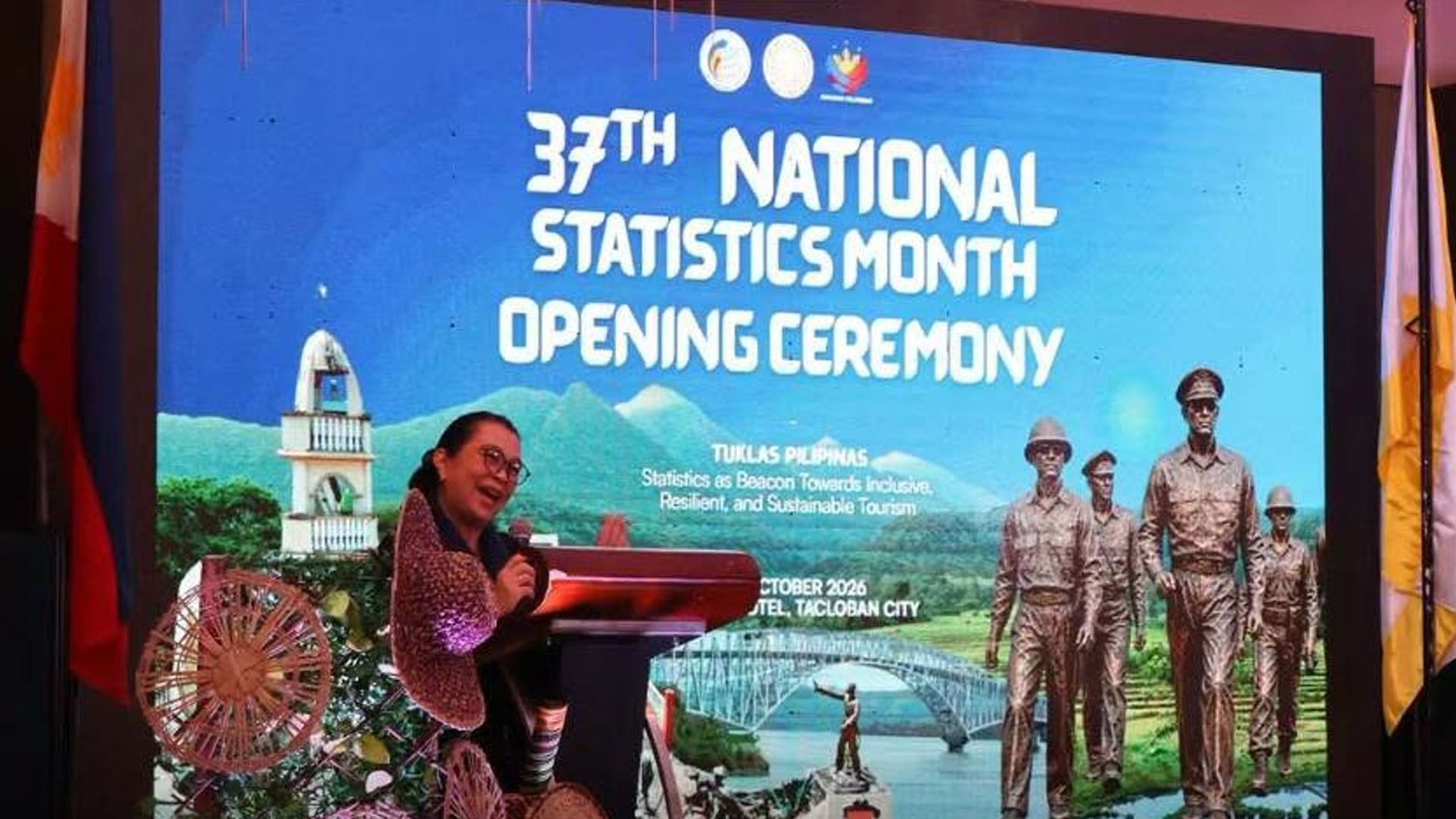







Reliable and timely tourism statistics are essential in guiding policies, identifying opportunities and addressing gaps toward a more inclusive, resilient and sustainable tourism industry in Eastern Visayas, regional officials said on Wednesday.
Department of Economy, Planning and Development (DEPDev) Regional Director Mylene Rosales said tourism statistics provide policymakers and industry stakeholders with critical information on visitor arrivals, accommodation occupancy and other indicators needed to assess the performance of the tourism sector.
“These numbers matter,” Rosales said in a press briefing, underscoring that stakeholders should look beyond the figures and examine the stories behind them.
She said tourism statistics should go beyond measuring industry performance and instead help explain what is happening in destinations and communities.
Specifically, they should answer the question of whether tourism is generating decent, meaningful jobs; which sectors and communities benefit most from the industry; which destinations need greater support regarding accessibility and transportation; and how resilient the industry is to disasters and other shocks, she added.
Department of Tourism-Eastern Visayas officer-in-charge Ma. Catherina Apostol also highlighted the importance of accurate data in determining the direction of tourism development in the region.
“Statistics can help us understand where tourism is now, where the opportunities are, where the gaps are, and where we need to go next,” Apostol said, adding that tourism decisions have far-reaching implications for destinations, community businesses and visitors, making accurate and timely statistics essential in planning.
Data from the DOT showed that Eastern Visayas recorded 2,814,548 overnight guests in 2025, comprising 2,769,018 domestic tourists and 45,530 foreign tourists.
The region also registered 6,506,021 same-day visitors, including 6,462,653 domestic visitors and 43,368 foreigners.
Overnight guests increased by 73 percent from 2024, while same-day visitors grew by 17 percent.
The 2025 figures also surpassed the region’s pre-pandemic tourism performance. Compared with 2019, overnight guest arrivals posted a 161 percent recovery rate, while same-day visitors reached 138 percent.
The region currently has a 36 percent accommodation occupancy rate, with average tourist expenditure estimated at PHP5,902.
Partial data for January to June 2026 showed that the region had recorded 781,941 overnight guests, including 767,308 domestic tourists and 14,633 foreigners.
During the same period, Eastern Visayas registered 1,778,133 same-day visitors, composed of 1,767,787 domestic tourists and 10,346 foreign visitors. These figures, however, only represent 50 to 60 percent of local government unit’s submissions.
Apostol said the statistics also indicate growing demand for experiential, cultural, nature-based, dive, cruise and community-based tourism experiences.
“These statistics are not simply measures of how many people visited Eastern Visayas. They help us understand the kind of tourism our visitors are looking for, and the opportunities that it creates for our destinations, our community, and our tourism enterprises,” she said.
She then called on local government units and tourism enterprises to submit accurate and timely data, saying complete information allows tourism stakeholders to monitor changes in visitor demand, identify emerging markets and assess destination performance.
“These numbers remind us why timely and reliable tourism statistics matter,” Apostol said, adding that tourism statistics are now also among the indicators considered under the Seal of Good Local Governance, further highlighting the importance of proper data submission by local governments.
“If statistics are meant to guide us, then we also need to look beyond the numbers, because a number tells us what is happening, it is the story behind the number that helps us understand why it is happening, who is affected, and what to do next,” she said.
The 37th National Statistics Month, observed throughout October, carries the theme “Tuklas Pilipinas: Statistics as Beacon Towards Inclusive, Resilient, and Sustainable Tourism.” (PNA)