



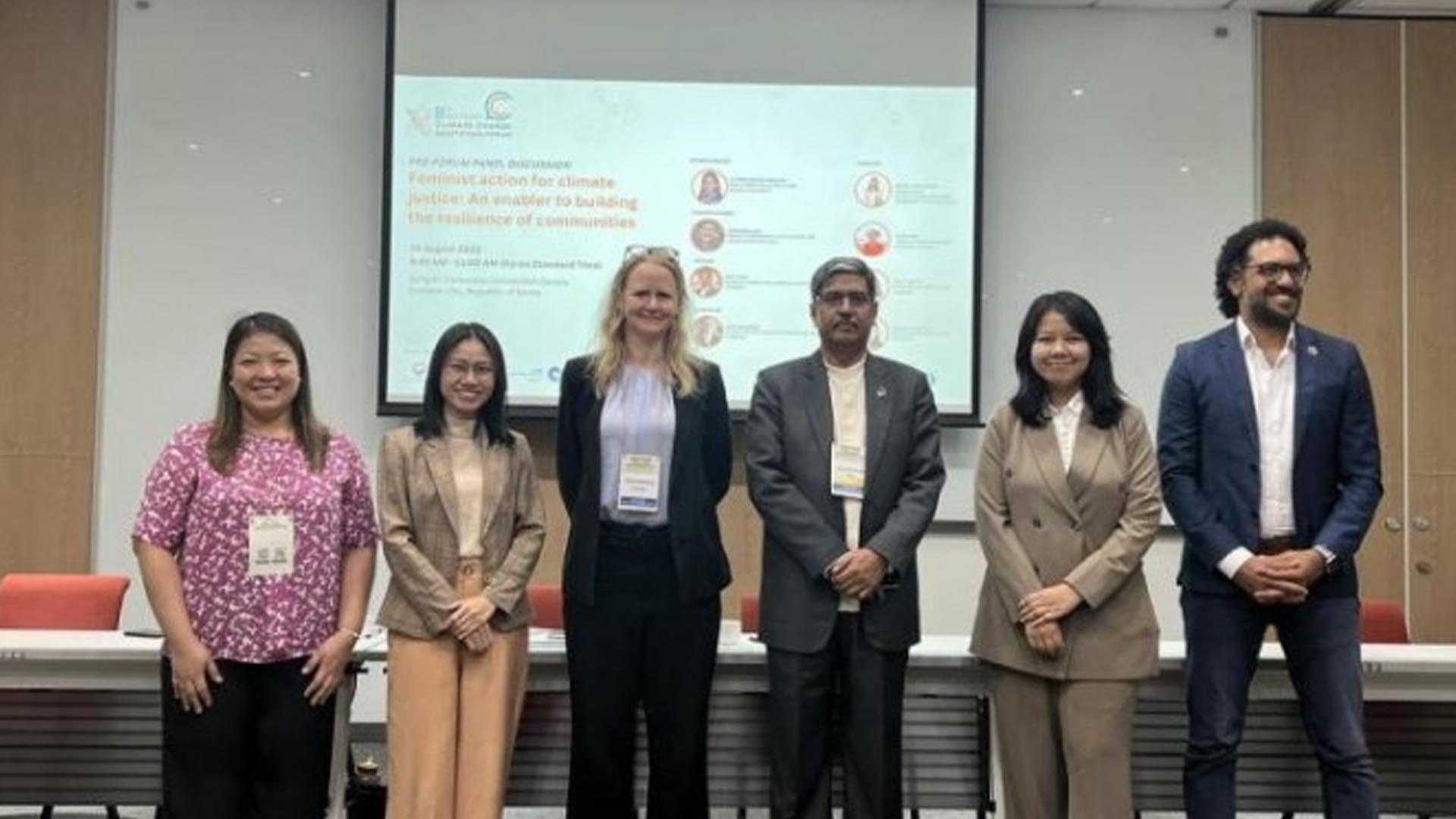







The Climate Change Commission (CCC) highlighted Philippine policies, partnerships and good practices that promote gender-responsive climate action during the 8th Asia-Pacific Climate Change Adaptation Pre-Forum Discussion in Incheon, Republic of Korea on Aug. 29.
CCC Commissioner Rachel Anne Herrera gave the country’s perspectives and experiences on integrating gender in climate action in the Philippines.
The panel discussion, organized by the UN Women Regional Office for Asia and the Pacific and the United Nations Environment Programme (UNEP), convened adaptation practitioners and policymakers in the Asia-Pacific region to share practical solutions and explore partnerships for advancing feminist action for climate justice.
“Climate impacts aggravate existing general inequalities, and societal and cultural norms for women affect our ability to respond and cope with climate impacts, which give rise to issues on access to basic resources and services, as well as decision-making,” Hererra said.
She provided insights on landmark laws that mainstream gender in the country’s policies and programs, including the Magna Carta of Women, which sets gender mainstreaming as the national strategy for gender and development; the Climate Change Act, which upholds gender-sensitive considerations in climate change plans, policies, programs, and projects; and the 5 percent mandatory appropriation of agency national budgets for gender and development.
She underscored enabling policies and programs, such as the National Climate Change Action Plan (NCCAP), which aims to build the adaptive capacities of both women and men and optimize mitigation opportunities towards gender-responsive and rights-based sustainable development; the CCC Resolution to mainstream gender and development in all government actions related to climate change; and the Climate Change Expenditure Tagging (CCET), which tracks and monitors climate-related projects and programs, including those for gender and development.
Best country practices that Herrera shared included the establishment of Climate Resiliency Field Schools, which reinforce the adaptive capacity of both men and women in the farming and fisheries sectors; the Women-Managed Marine and Coastal Areas Program, which established database information, documented success stories of women fisherfolk, provided technical assistance for women’s participation, and forged partnerships with stakeholders in the conservation and management of natural marine habitats; and the Gender-Responsive Livelihood Assistance, which provides employment that promotes climate- and community-friendly projects.
Herrera called for “investing in women’s climate resilience” and urged participants to continue empowering more women to meaningfully participate in climate actions.
“Support women’s access to renewable energy and low-carbon technologies and build infrastructure and facilities that cater to the needs of women and girls in times of disaster,” she said.
As gender gaps and violence are magnified during times of disasters and extreme weather, she said local government units should enhance their disaster response and management by anticipating their needs and investing in infrastructure and facilities, including separate comfort rooms, changing rooms, and other amenities for maternal healthcare and wellness needs.
Herrera said women’s active participation in climate change policy and programming should be made accessible to them.
“Ease the burdens that women face. A climate resilient world would have women placed at the table as visionaries and leaders so that our effective strategies for transformational adaptation are fulfilled,” she said. (PNA)