




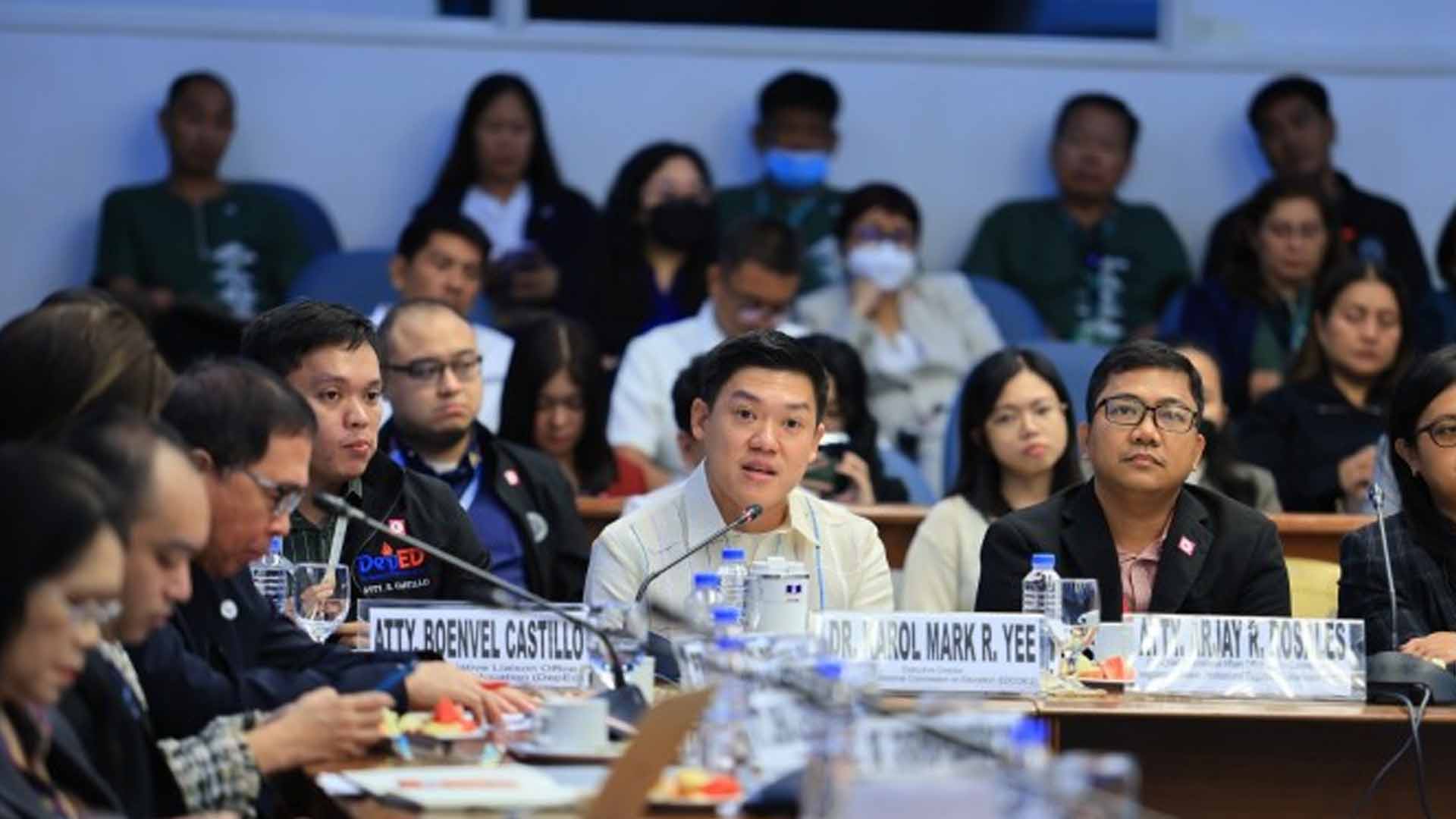







Removing the restrictions on foreign ownership and management in the 1987 Constitution is seen as a first step in the internationalization of Philippine higher education, making it globally competitive, an official of the Second Congressional Commission on Education (EDCOM II) said Tuesday.
At the resumption of the Senate’s discussion on Resolution of Both Houses No. 6 (RBH 6) Tuesday, EDCOM II Executive Director Dr. Karol Mark Yee said there is a need to clearly set the government’s vision and targets in opening up education to full foreign ownership.
One of the proposals under RBH 6 is the amendment of Article XIV of the Constitution on ownership of educational institutions.
Yee cited Singapore and Malaysia as examples where generous government incentives were rolled out and adjusted policies to attract the best international institutions.
“This will require other legislation to be able to do this. There is also a need to strengthen the capacity of the Department of Education, Commission on Higher Education, and Technical Education and Skills Development Authority to regulate the possible entry of poor quality institutions,” he told senators.
The industries, Yee said, should also strengthen its partnership with educational institutions to maximize research.
Basic education not included
Senator Sonny Angara, who chairs the subcommittee discussing RBH 6, reiterated that the measure only intended to tackle higher education and “keep basic education in the hands of Filipinos.”
“It is important to state that before we actually seek to amend the Constitution on ownership or management of higher education institutions, perhaps we should aim at greater precision in the language of the amendments since some of those who read Resolution [of Both Houses] No. 6 interpreted to mean that Congress would also be able to amend basic education. I think that’s not the intention of the Senate President, Senator Legarda, and myself in filing Resolution [of Both Houses] No. 6 on the education provisions,” Angara said during the hearing.
Angara cited Republic Act 11448 or the transnational higher education law, which allows a 60-40 ownership arrangement in favor of Filipinos, as implementing legislation for the constitutional provision.
“So I think we want to maintain that societal or public goal, and we’re really looking at the possibility of amending the constitutional provision, which currently allows a 60-40 arrangement,” Angara said.
He also emphasized the need to clarify the scope of the proposed amendment to the constitutional provision on ownership or management of higher education institutions amid concerns about its potential impact on basic education.
The EDCOM II was created through Republic Act 11899 in July 2022, tasked to undertake a comprehensive national assessment and evaluation of the performance of the Philippine education sector. (PNA)