












Impeachment is supposed to be the constitutional moment when power pauses and accountability speaks. That is the theory. What we are seeing now is something else entirely.
The impeachment narratives surrounding Vice President Sara Duterte and the impeachment noise occasionally thrown at President Ferdinand Marcos Jr. reveal less about legal accountability and more about how power is normalized through media framing.
Across Philippine media, impeachment is no longer framed as an endgame. It is framed as background noise.
The core pattern
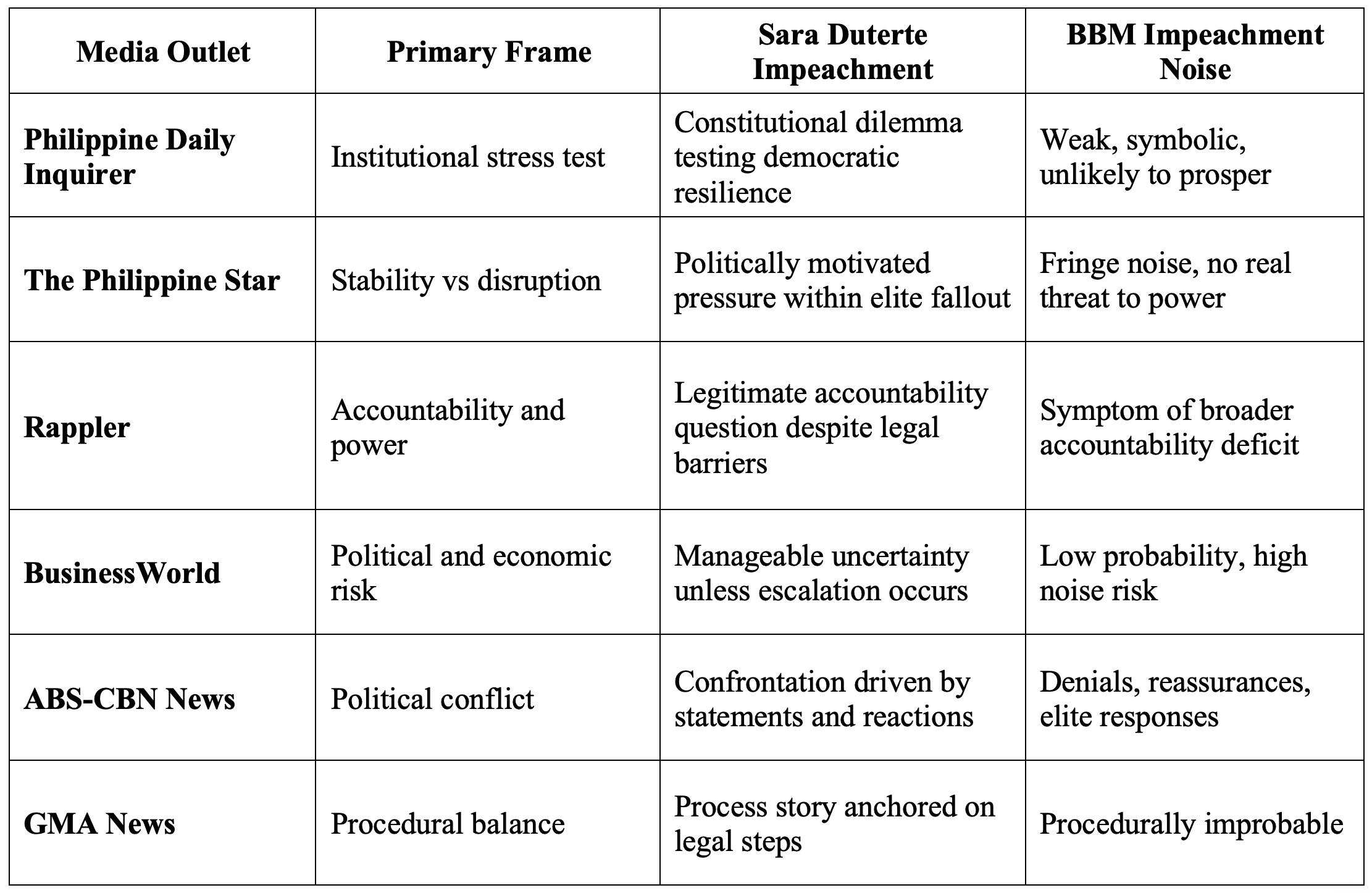
Sara Duterte’s impeachment is framed as dangerous but constrained. BBM’s impeachment is framed as possible but implausible.
Both frames lead to the same conclusion: power remains intact, institutions absorb the shock, and citizens are left watching a process that goes nowhere.
This is not accidental. It is the result of how impeachment stories are told.
Table 1
How the Press Frames Impeachment
What these frames do
Notice what is missing.
Very few stories ask what impeachment does to governance. Most stories ask whether impeachment will work. That is a crucial difference.
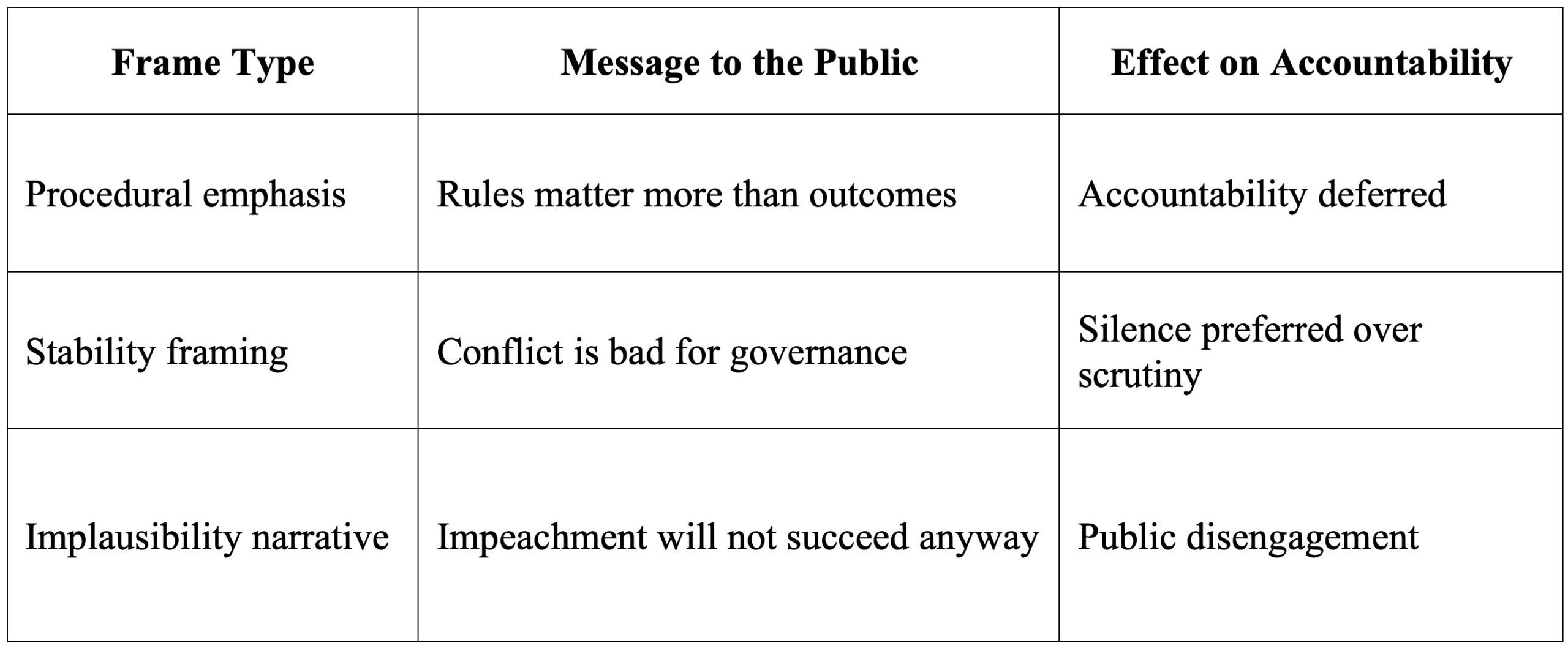
By repeatedly emphasizing procedure, improbability, and stability, media coverage quietly resets public expectations. Impeachment becomes something that can be filed, debated, dismissed, and forgotten without consequence.
In this framing environment, impeachment does not threaten power. It reassures it.
Table 2
What the Frames Signal to Citizens
The asymmetry problem
The vice president is framed as politically embattled but institutionally protected. The president is framed as institutionally secure and politically insulated.
That asymmetry matters.
It creates a system where impeachment exists mainly as signaling. Signals of division. Signals of conflict. Signals of dysfunction. But not signals of consequence.
Power survives. Direction does not.
Why this matters
In a functioning democracy, impeachment clarifies responsibility. In the current framing ecosystem, impeachment obscures it.
What citizens receive is not a clear narrative of accountability, but a steady diet of political noise. Noise that crowds out policy, governance, and long-term reform. Noise that teaches people that nothing really changes, no matter how loud the accusations become.
This is how accountability erodes quietly. Not through repression, but through normalization.
Power without momentum
President Marcos is not losing power. That remains the most misunderstood reading of the moment. What is being lost is momentum, legitimacy, and narrative direction.
And impeachment, as currently framed, is not stopping that erosion. It is accelerating it.
When impeachment becomes routine noise rather than constitutional rupture, power stops fearing consequences. It only learns how to wait.
That may be politically survivable. It is not reputationally sustainable.