




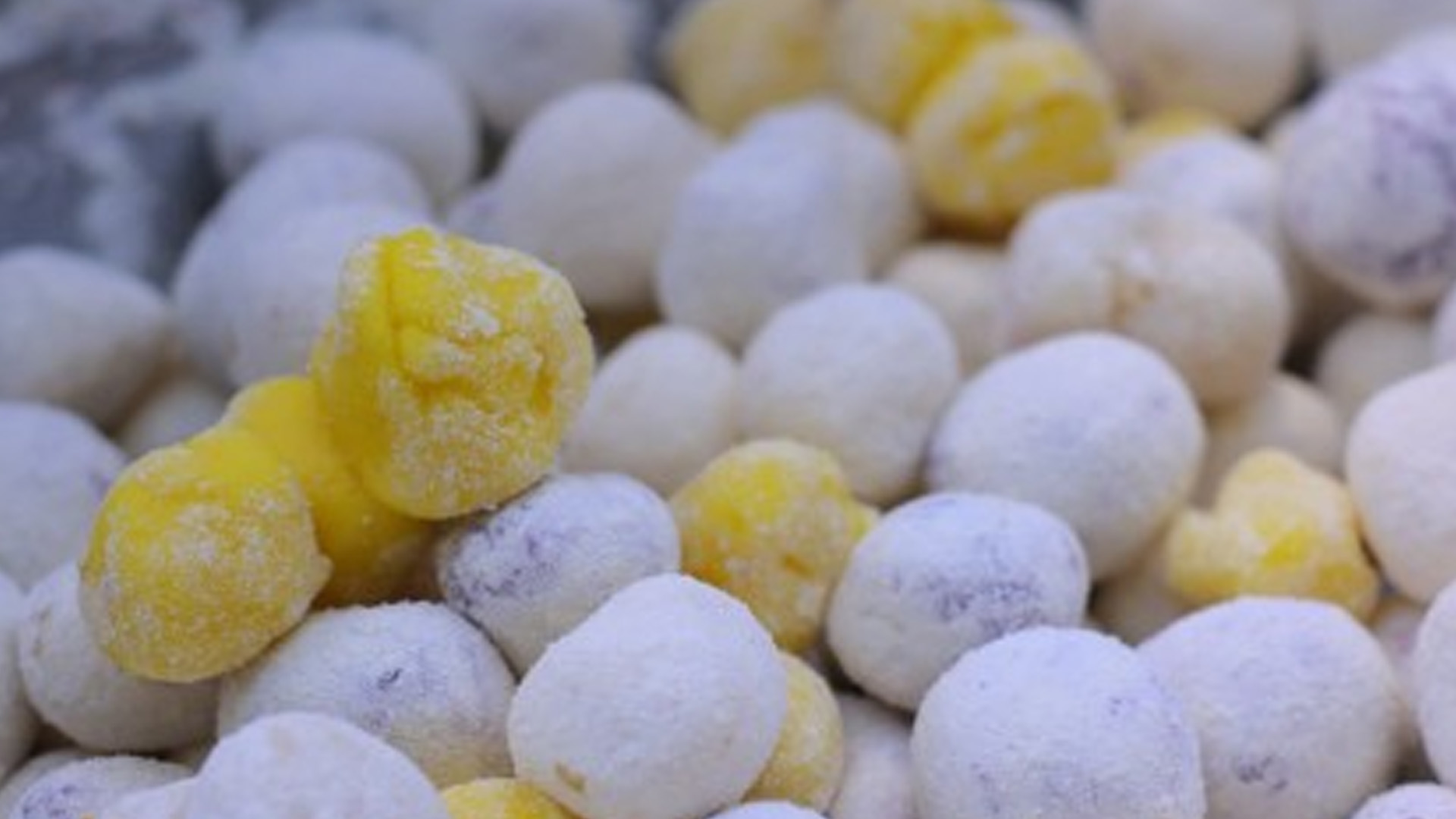







This town, known as the center of Roman Catholic faith in Eastern Visayas, is keeping its Holy Week tradition of preparing “molabola”, a local delicacy that became a symbol of faith.
Even with the presence of fast food in this town, family members get involved in creating this dish classified as slow food, prepared using traditional methods and high-quality, usually local ingredients.
Lenten delicacy
Molabola is a rice-based dish traditionally prepared on Good Friday during Holy Week as a meatless meal and features soft, chewy rice balls cooked in coconut milk, sugar, and ginger.
The preparation, on its own, is a form of penitence and offering from the backbreaking shaping of the glutinous rice into hundreds of bite-sized rice balls to the sweat-pouring continuous stirring of boiling coconut milk in a large cauldron.
On April 15, the local government held the Molabola Festival that brought together culinary talents from across Palo town. Participants showcased their skills in preparing the traditional delicacy.
It is one of the opening activities for the Pamalandong ha Palo 2025, along with the kickoff of the annual Visita Iglesia at the town plaza. Pamalandong is a re-enactment of the Lord’s Passion celebrated in town every Good Friday.
Palo municipal tourism officer Nariza Marasigan said what makes molabola distinct is not just its ingredients but the way it’s lovingly prepared.
“Over time, molabola has become more than just food for many of our people; its preparation has become a sacred act of preservation of memory, culture, and faith,” Marasigan said.
Before Good Friday comes, family members are involved in grinding the glutinous rice and shaping it into bite-sized balls, and all the while stories are bantered around and family rituals are shared, unconsciously passing down a tradition to the next generation.
One of the festival’s participants is Josephine Palejo, from San Jose village, where she presented her unique version of molabola mixed with jackfruit and paired with a refreshing pandan coconut drink.
“This event also encourages community spirit, as families and friends gather to share in the preparation and enjoyment of molabola, fostering a sense of unity,” Palejo said.
The festival features an exciting competition where pairs of contestants prepare traditional, modern, and fusion versions of the dish, paired with creative drinks.
The competition’s rules ensure that all recipes are freshly crafted on-site, with 20 pairs of participants showcasing their culinary flair and innovation while honoring the traditional flavors of molabola.
The local government has not yet announced the festival winners.
Solemnity and faith
Holy Week in Palo is deeply solemn, with the town being a historical center of Catholicism in Leyte. People observe fasting and abstinence. Molabola, being a meatless, simple dish, has become the perfect dish for the occasion.
It is served after the “pabasa” and following long processions or silent moments of prayer inside the Palo Metropolitan Cathedral. It is served to the “Penitentes” after walking on foot during Good Friday, and it is freely given to visitors and families alike during this sacred season.
Palo town is home to the offices of the ecclesiastical government of the Roman Catholic Archdiocese of Palo, the archbishop’s residence, and the secondary, tertiary, and theology seminaries of the archdiocese.
The diocese has 1.2 million Roman Catholic residents, 63 parishes, one chaplaincy, and 13 mission stations, divided into two districts—the Eastern District for Waray-speaking people and the Western District for Cebuano-speaking residents. (PNA)