




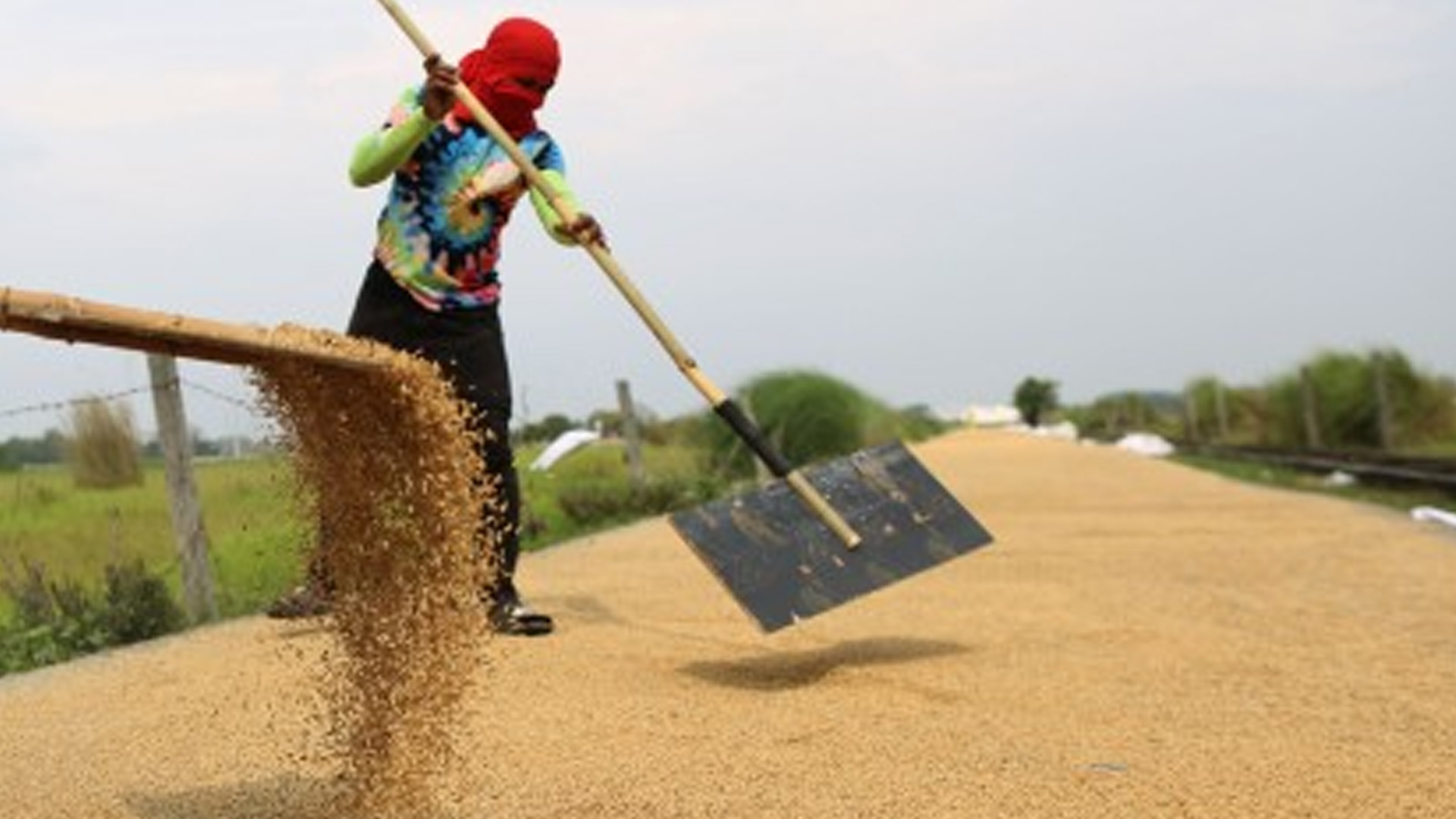







The Department of Agriculture (DA) on Wednesday highlighted a record-high palay (unhusked rice) harvest for the second quarter, marking the highest volume in nearly four decades.
The Philippines logged a record 4.63 million metric tons (MT) of palay output from April to June, according to the Philippine Statistics Authority (PSA).
This is equivalent to a 5.7 percent year-on-year hike, which is considered the highest second-quarter harvest since 1987.
In a statement, DA Secretary Francisco Tiu Laurel Jr. said government intervention has helped advance stable supply and support to farmers.
This is in line with the directives of President Ferdinand R. Marcos Jr. to ensure food security and profitability of Filipino food producers.
“The agency is applying lessons from the 2024 El Niño, shifting its strategy from crisis response to early preparation to safeguard both food supplies and farmer incomes,” Tiu Laurel said.
In particular, an unprecedented 1.04 million hectares of harvested area contributed to the record-high second-quarter harvest.
This area helped lift overall production despite the slight drop in the average yield, equivalent to a 0.7 percent drop to 4.47 MT per hectare from 4.50 MT per hectare.
The high harvested area, which expanded by 6.5 percent, demonstrated the country’s favorable growing conditions and improved market profitability, which have intensified farmers’ cropping intention, as well as the sustained government support.
Tiu Laurel attributed the improved market conditions to the four-month rice import ban from September to December last year, prompting better earning opportunities for palay farmers.
The second-quarter harvest also offset the weaker first quarter, resulting in a 9 million MT overall first-semester palay output.
Bracing for a strong El Niño
The agency assured preparations for the impact of the looming strong El Niño phenomenon, both for Filipino farmers and consumers.
This comes as the PSA projected a 13.3 percent drop in third-quarter palay output, based on the standing crops as of July 1.
According to the PSA, palay output may fall to 3.25 million MT by the third quarter, lower than 3.75 million MT in the same period last year.
“Food security means being proactive. We must keep farmers planting despite higher costs and the threat of El Niño,” Tiu Laurel said.
For farmers, the agency vowed to strengthen domestic support through an expanded palay procurement under the National Food Authority (NFA).
About 500,000 metric tons of palay will be procured at a higher price, pegged at PHP21 per kg. for wet palay, and PHP25 to PHP27 per kg. for clean and dry palay.
On Tuesday, Tiu Laurel said the grains agency has about PHP20 billion in allocation for palay procurement, more than twice as high as last year’s PHP9 billion funding.
Besides stronger NFA buying, the DA will sustain the provision of financial assistance, crop insurance, irrigation support, quality seeds, mechanization services, and intensified investments in drying, storage, and other post-harvest facilities.
Close monitoring, field validation, and remote sensing will also be in place to prepare for the impact of the strong El Niño.
Moreover, members of the vulnerable sector may also benefit from the sustained PHP20 per kg. rice under the Benteng Bigas Meron (BBM) Na in Kadiwa ng Pangulo (KNP) sites and accredited outlets nationwide.
To ensure a stable supply of affordable retail rice nationwide, the DA also assured that no rice import ban will be imposed amid the wet harvest season.
Tiu Laurel earlier said rice stocks in local markets must remain adequate until April next year, or ahead of the dry-season harvest in 2027.
As of Aug. 2, rice import arrivals were logged at 3.5 million MT, according to the DA. (PNA)